

Fire extinguisher compliance is an important responsibility for Texas businesses, property managers, facility teams, and building owners. Having extinguishers mounted on the wall is only one part of maintaining a prepared and compliant property.
Fire extinguishers need to be properly selected, correctly located, accessible, inspected, maintained, documented, and ready for use when an emergency occurs.
For businesses in North Texas, understanding the difference between routine inspections, professional maintenance, equipment replacement, and employee preparedness can make fire safety much easier to manage.
At Grace Under Fire, our approach is built around more than checking a tag. Our firefighter-led team focuses on compliance, readiness, documentation, and practical fire-safety education for commercial properties throughout North Texas.
What Does Fire Extinguisher Compliance Mean for a Texas Business?
Fire extinguisher compliance Texas businesses need to maintain involves several areas of responsibility.
A commercial property should have the appropriate extinguishers for the hazards present, installed in suitable locations, accessible to occupants, and maintained according to applicable requirements.
Compliance also involves keeping accurate service records and addressing deficiencies when an extinguisher is damaged, discharged, inaccessible, improperly located, or otherwise not ready for service. Texas regulates portable fire extinguisher work through the Texas Department of Insurance and State Fire Marshal’s Office. The state licensing framework includes requirements for companies and individuals performing regulated extinguisher work. This is why property managers should look beyond simply asking whether an extinguisher has a current-looking tag.
Monthly Inspection vs. Annual Professional Maintenance
One of the most common areas of confusion for businesses is the difference between an inspection and professional maintenance. Under NFPA 10 provisions, portable fire extinguishers generally require inspection at intervals not exceeding 31 days, subject to applicable exceptions. Professional maintenance is a separate and more detailed process.
Monthly Inspection
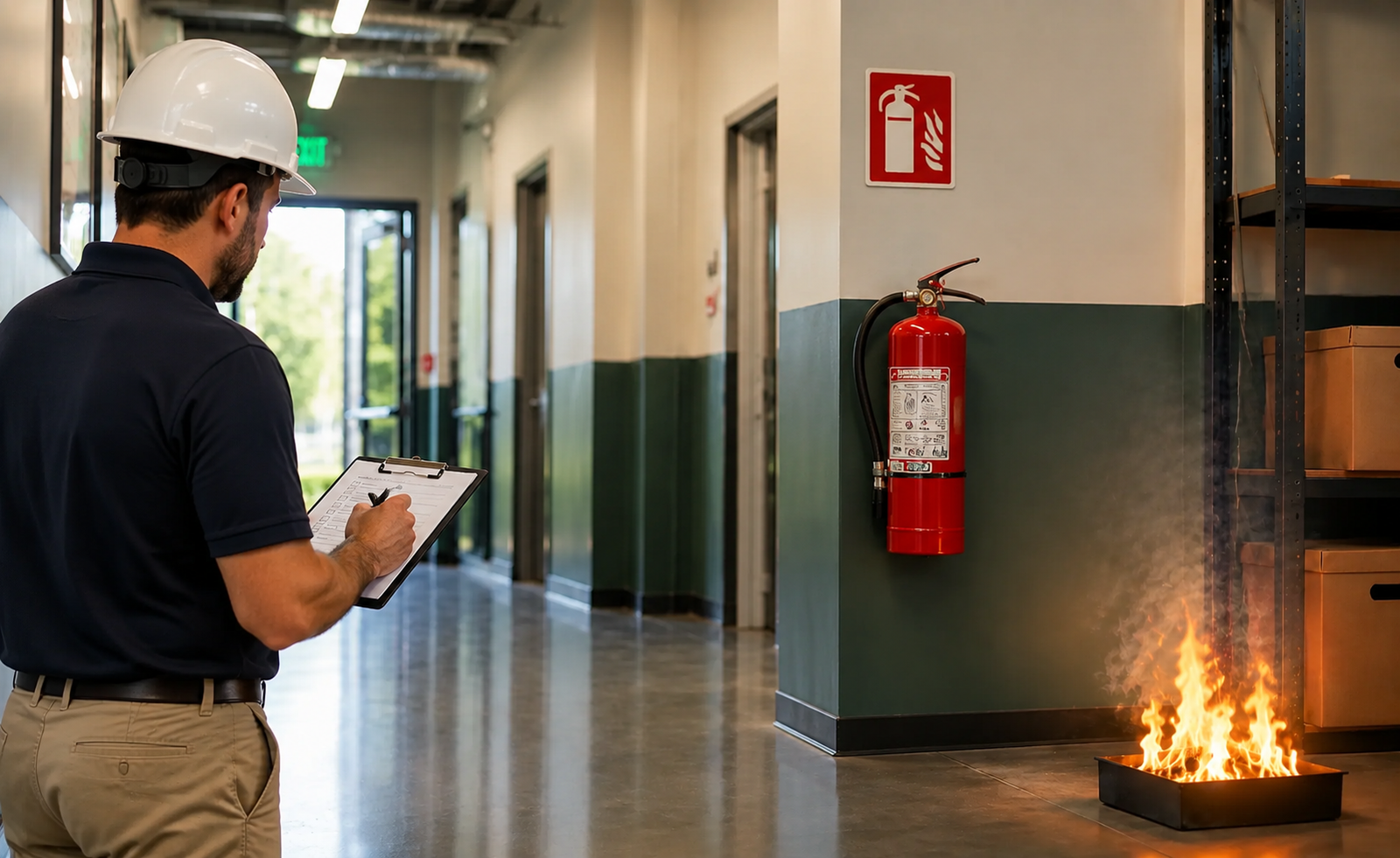
A routine inspection focuses on visible readiness. A responsible person should verify that:
- The extinguisher is in its designated location.
- The extinguisher is visible and accessible.
- Nothing is blocking access.
- There is no obvious physical damage.
- There are no visible signs of leakage or corrosion.
- The pressure indicator is in the appropriate range where applicable.
- The safety pin and tamper seal are present.
- The hose and nozzle appear to be in good condition.
- Labels and operating instructions remain readable.
- The inspection is properly documented.
If a problem is identified, it should not simply be ignored until the next scheduled service.
Annual Professional Maintenance
Annual maintenance goes beyond a visual check.
A qualified professional evaluates the extinguisher’s condition, service history, components, and applicable maintenance requirements. Depending on the extinguisher type and condition, professional service may involve maintenance, recharge, testing, repair, or replacement. NFPA materials distinguish routine inspection from professional maintenance and emphasize that detailed maintenance should be performed by appropriately trained personnel using the applicable manufacturer information and procedures.
This distinction is important for property managers because completing monthly checks does not eliminate the need for professional maintenance.
Why NFPA 10 Matters
NFPA 10 fire extinguisher requirements provide a national framework for the selection, installation, inspection, maintenance, recharging, and testing of portable fire extinguishers.
The standard addresses issues such as extinguisher placement, accessibility, inspection frequency, maintenance, and testing.
For Texas businesses, NFPA 10 works within the state’s applicable regulatory and licensing framework. The exact requirements for a property can depend on occupancy, hazards, equipment type, manufacturer requirements, and applicable local provisions.
That means businesses should avoid using a generic checklist as a substitute for professional evaluation.
A restaurant kitchen, warehouse, office building, medical facility, construction site, and multifamily property can have very different fire hazards and equipment requirements.
Choosing the Right Fire Extinguisher for the Environment
Fire extinguishers are not one-size-fits-all equipment. The type and placement of extinguishers should reflect the hazards present in the property.
For example:
Offices
Office environments may have risks associated with paper, furniture, electrical equipment, and other ordinary combustibles.
Restaurants
Commercial kitchens can involve cooking-oil and grease hazards, requiring appropriate protection for the environment.
Warehouses
Warehouses and industrial facilities may have larger areas, storage hazards, equipment, machinery, chemicals, or other specialized risks.
Construction Sites
Construction environments change frequently. Extinguishers can be exposed to movement, dust, weather, physical damage, and changing hazards.
Multifamily Properties
Apartment and multifamily properties can require consistent management across multiple buildings, common areas, tenant spaces, and maintenance areas.
Grace Under Fire currently supports commercial environments including retail, restaurants and hospitality, warehouses, offices, multifamily communities, construction sites, houses of worship, and property-management portfolios.
Why Documentation Is an Important Part of Compliance
Fire safety isn’t only about the equipment.
Documentation provides a record of what was inspected, serviced, replaced, or identified as needing attention.
For property managers responsible for multiple buildings or locations, organized documentation can make it easier to:
- Track inspection dates
- Monitor service history
- Identify deficiencies
- Schedule future maintenance
- Verify completed work
- Maintain property records
- Communicate with owners and management teams
Texas also has specific requirements surrounding regulated extinguisher service and service tags.
A well-managed documentation process therefore supports both operational readiness and compliance management.
What Happens When a Fire Extinguisher Has a Deficiency?
A deficiency doesn’t always mean the extinguisher needs to be immediately replaced.
The appropriate response depends on the condition and type of problem.
Common issues can include:
- Low pressure
- Corrosion
- Physical damage
- Leakage
- Missing components
- Damaged hose or nozzle
- Obstructed access
- Improper placement
- Illegible instructions
- Required maintenance or testing being overdue
- Evidence of discharge
Some issues, such as blocked access, may be corrected immediately.
Equipment-related problems should be evaluated by an appropriately qualified professional. Depending on the situation, the appropriate solution may involve maintenance, recharge, testing, repair, or replacement.
The goal should always be to ensure that removing an extinguisher from service does not leave the property without appropriate protection.
Fire Extinguisher Compliance Is About Readiness, Not Just a Tag
A current inspection tag is important, but it should not be treated as the entire fire-safety program.
A business can have documentation and still have practical readiness problems.
For example, an extinguisher might technically have been serviced but later become blocked by inventory, moved during remodeling, damaged, or placed somewhere that employees cannot easily access.
That is why ongoing awareness matters.
Grace Under Fire’s compliance approach combines inspection, installation, service, replacement, documentation, and education. The company’s current compliance program also emphasizes helping businesses understand when an extinguisher may be appropriate and when evacuation is the safer response.
The objective is simple:
Keep the equipment ready. Keep the documentation organized. Keep people prepared.
Why Work With a Firefighter-Led Team?
Fire-safety compliance involves technical requirements, but emergency readiness also involves human decision-making.
Grace Under Fire was founded by Greg Lawler, a retired Fire Captain with 34 years of service, according to the company’s website. The organization describes its approach as firefighter-led and focused on compliance, readiness, and education.
That experience is relevant because fire safety isn’t limited to equipment.
People need to understand:
- Where extinguishers are located
- What hazards exist in their environment
- How to recognize an early-stage fire
- When an extinguisher may be appropriate
- When evacuation is necessary
- How to maintain clear exit routes
- Who is responsible for emergency communication
For businesses, this practical understanding can complement the formal inspection and maintenance process.
Building a Fire Extinguisher Compliance Program
Property managers and business owners can use a simple framework to stay organized:
1. Identify Your Fire Hazards
Understand the types of hazards present in each area of the property.
2. Review Extinguisher Placement
Make sure equipment remains visible, accessible, and appropriate for the environment.
3. Perform Routine Inspections
Maintain the required inspection schedule and document the results.
4. Schedule Professional Maintenance
Use appropriately qualified and licensed professionals for regulated service.
5. Address Deficiencies
Do not leave damaged, discharged, inaccessible, or otherwise deficient equipment unresolved.
6. Maintain Documentation
Keep service and inspection records organized for the property.
7. Educate Your Team
Employees and occupants should understand the property’s emergency procedures and the organization’s expectations regarding extinguisher use.
8. Review the Program Regularly
A property changes over time. Remodeling, new equipment, changes in occupancy, storage changes, and new hazards can affect fire-safety needs.
Final Thoughts
Fire extinguisher compliance should be treated as an ongoing responsibility rather than a once-a-year task.
For Texas businesses, the process involves more than installing extinguishers and checking a service tag. Proper equipment selection, placement, routine inspection, professional maintenance, documentation, and employee education all contribute to a stronger fire-safety program.
Grace Under Fire works with businesses and property-management teams across North Texas to support inspection, installation, service, replacement, documentation, and education.
If you’re unsure whether your property’s current fire extinguisher program is properly maintained, a professional compliance review can help identify gaps and determine what needs attention.
Ready to review your property’s fire extinguisher compliance? Contact Grace Under Fire to discuss your inspection, service, documentation, or training needs.
Frequently Asked Questions
1. How often should commercial fire extinguishers be inspected in Texas?
Portable fire extinguishers generally require routine inspection at intervals not exceeding 31 days, subject to applicable exceptions, along with professional maintenance according to NFPA 10 and applicable Texas requirements. The exact requirements can depend on the property, extinguisher type, occupancy, and applicable regulations.
2. Is a monthly fire extinguisher inspection the same as annual maintenance?
No. A monthly inspection is primarily a routine readiness check for visible conditions such as location, accessibility, pressure indication, damage, and missing components. Annual professional maintenance is a more detailed process performed according to applicable standards, manufacturer requirements, and Texas regulations.
3. Who can service commercial fire extinguishers in Texas?
Regulated portable fire extinguisher installation, certification, and service must be performed within the Texas licensing framework. The Texas Department of Insurance states that an FEL-B license permits an individual to install, certify, or service portable fire extinguishers, while the company must have the appropriate registration.
4. What should a business do if an extinguisher fails an inspection?
The deficiency should be documented and evaluated. Depending on the issue, the appropriate response may be correction, professional maintenance, recharge, testing, repair, or replacement. Businesses should also ensure that temporarily removing an extinguisher does not leave the area without appropriate fire protection.