

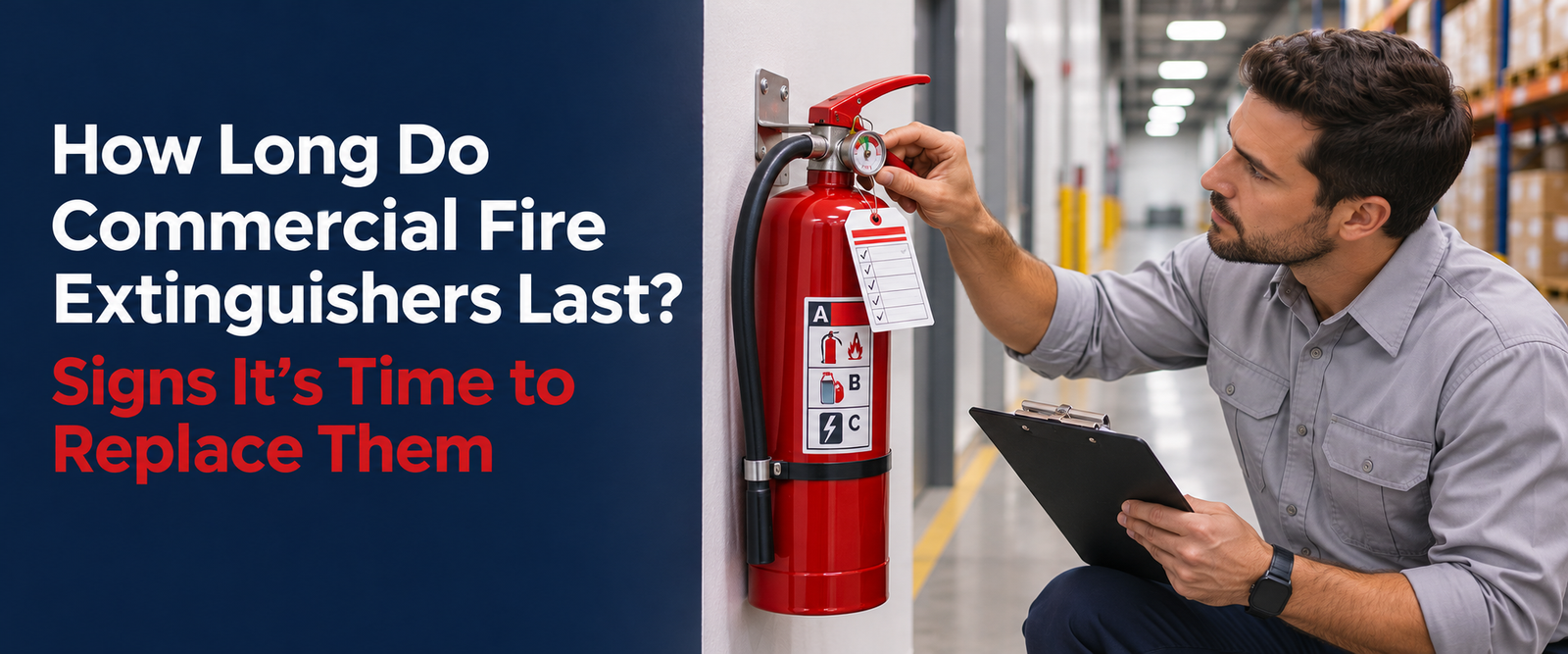
Fire extinguishers are one of the most important safety devices in any commercial building. Whether you operate an office, restaurant, warehouse, retail store, school, or industrial facility, having properly maintained fire extinguishers can help control small fires before they become serious emergencies.
However, simply installing fire extinguishers is not enough. Over time, eqipment can lose pressure, develop corrosion, experience mechanical damage, or become outdated. Even an extinguisher that looks perfectly fine from the outside may not function properly during an emergency.
So, how long do fire extinguishers last?
The answer depends on the extinguisher type, manufacturer recommendations, maintenance history, and applicable fire safety requirements. Many commercial fire extinguishers have an expected service life of approximately 10–12 years, but this is not a universal expiration rule. Some units require servicing, internal maintenance, or hydrostatic testing much sooner.
Understanding the warning signs and inspection requirements can help business owners maintain reliable fire protection and avoid unnecessary compliance issues.
How Long Do Commercial Fire Extinguishers Last?
Most commercial fire extinguishers can remain in service for approximately 10–12 years when properly maintained. However, their actual lifespan depends on several factors, including the type of extinguisher, storage conditions, frequency of use, and manufacturer specifications.
Different extinguishers also have different maintenance and testing schedules.
For example:
- ABC Dry Chemical Extinguishers: Commonly require six-year internal maintenance and 12-year hydrostatic testing when applicable.
- CO2 Fire Extinguishers: Generally require hydrostatic testing every five years under OSHA requirements.
- Water-Based Extinguishers: Typically require hydrostatic testing every five years.
- Foam Fire Extinguishers: Testing intervals generally depend on the specific type and construction, with many requiring five-year hydrostatic testing.
These are testing and maintenance intervals, not automatic replacement dates. Always check the extinguisher label, manufacturer instructions, and applicable regulations.
According to OSHA’s 29 CFR 1910.157, employers must ensure workplace fire extinguishers are inspected, maintained, and tested as required.
Internal Link Suggestion: Learn more about commercial fire extinguisher compliance and inspection services.
7 Warning Signs It’s Time to Replace Your Fire Extinguisher
Even if a fire extinguisher has not reached its expected service life, certain conditions may indicate that it needs immediate professional attention or replacement.
Here are seven warning signs every business owner should recognize.
1. The Pressure Gauge Is Outside the Green Zone
Most stored-pressure fire extinguishers have a pressure gauge that indicates whether the unit is properly charged.
If the needle falls below the green zone, the extinguisher may not have enough pressure to discharge effectively.
A gauge reading above the recommended range can also indicate a problem.
Never assume an extinguisher is ready for an emergency simply because it is mounted on the wall. Have any abnormal pressure reading evaluated by a qualified fire extinguisher professional.
2. Visible Rust or Corrosion
Fire extinguishers are often installed in areas exposed to moisture, temperature changes, dust, or chemicals.
Over time, these conditions can cause rust and corrosion on the cylinder.
Corrosion is particularly concerning because it can weaken the extinguisher’s structural integrity.
If you notice significant rust, pitting, or corrosion, remove the unit from service when required and arrange a professional evaluation. A severely damaged cylinder may need replacement rather than repair.
3. Physical Damage or Leakage
Dents, cracks, damaged valves, and chemical leakage are serious warning signs.
Even minor-looking damage can affect the extinguisher’s ability to maintain pressure or operate safely.
Check the cylinder, handle, valve assembly, and base for visible damage.
If you identify leakage or significant physical damage, do not attempt to repair the equipment yourself. Have it evaluated by a qualified technician.
4. Broken Safety Pin or Tamper Seal
The safety pin and tamper seal help prevent accidental discharge.
If the pin is missing or the seal is broken, the extinguisher may have been tampered with or partially discharged.
This does not automatically mean the unit needs replacement, but it should be inspected immediately.
A professional can determine whether recharging, servicing, or replacement is necessary.
5. Damaged Hose or Nozzle
The hose and nozzle direct the extinguishing agent toward the fire.
Cracks, blockages, loose connections, and other damage can prevent proper discharge.
During a workplace inspection, make sure these components are present, clean, properly connected, and in good condition.
A damaged hose or nozzle should be repaired or replaced according to the manufacturer’s requirements.
6. Missing Inspection Records or Outdated Service Tags
Inspection documentation is an important part of commercial fire safety compliance.
If your fire extinguishers have missing service tags, outdated maintenance records, or no identifiable testing history, it may be difficult to establish whether they have received the required maintenance.
Businesses should maintain accurate records showing relevant inspection, maintenance, recharge, and hydrostatic testing dates.
A professional inspection can help identify missing documentation and determine what service is needed.
7. Failed Hydrostatic Testing
Hydrostatic testing checks the structural integrity of an extinguisher cylinder by subjecting it to controlled liquid pressure.
It helps identify weaknesses, leaks, and other problems that may not be visible during a routine visual inspection.
If an extinguisher fails hydrostatic testing or is found unsuitable for testing, it must be removed from service under applicable OSHA requirements.
Replacing the equipment is often necessary when the cylinder cannot safely remain in service.
What Are the Fire Extinguisher Maintenance Requirements?
Fire extinguisher maintenance is not just a recommendation for businesses. Specific workplace requirements are established under OSHA regulations, while NFPA 10 provides additional standards for portable fire extinguisher selection, inspection, maintenance, and testing.
Here are some important requirements business owners should understand.
Monthly Visual Inspections
OSHA requires monthly visual inspections of workplace portable fire extinguishers covered by 29 CFR 1910.157.
During these inspections, businesses should check:
- Whether the extinguisher is in its designated location.
- Whether it is visible and accessible.
- Whether the pressure gauge shows an appropriate reading.
- Whether the safety pin and tamper seal are intact.
- Whether the cylinder has visible damage, corrosion, or leakage.
- Whether the operating instructions are readable.
These checks help identify problems before an emergency occurs.
Annual Maintenance
OSHA requires an annual maintenance check for workplace portable fire extinguishers covered by its standard.
This maintenance helps ensure the extinguisher remains in proper working condition.
The annual maintenance date must also be recorded as specified under the regulation.
Six-Year Maintenance
Certain stored-pressure dry chemical extinguishers requiring a 12-year hydrostatic test must be emptied and receive applicable maintenance every six years.
Non-refillable disposable units are exempt from this particular six-year requirement.
Hydrostatic Testing
Hydrostatic testing is required at intervals that depend on extinguisher type and cylinder construction.
Under OSHA’s requirements, many common portable extinguishers have five-year or 12-year testing intervals.
Testing must be performed by trained individuals with appropriate equipment and facilities.
For detailed information, businesses can review OSHA’s portable fire extinguisher inspection and testing requirements.
What Happens After a Failed Fire Safety Inspection?
A failed fire safety inspection can create operational challenges for businesses, especially when important fire protection equipment is missing, damaged, inaccessible, or improperly maintained.
The consequences depend on the type of violation, the applicable authority, and the severity of the safety concern.
Here are some steps that businesses may need to take after a failed inspection.
1. Review the Inspection Report
Start by carefully reviewing the inspection report.
Identify every issue listed by the inspector, including missing extinguishers, incorrect placement, low pressure, damaged equipment, and incomplete maintenance records.
Understanding the specific violations will help you prioritize corrective actions.
2. Correct Identified Violations
Businesses should arrange the necessary repairs, maintenance, replacement, or installation of fire protection equipment.
For example:
- Replace damaged or unreliable extinguishers.
- Recharge units that require recharging.
- Correct improper extinguisher placement.
- Make blocked extinguishers accessible.
- Update missing maintenance documentation.
- Arrange required hydrostatic testing.
3. Arrange a Professional Fire Extinguisher Inspection
A qualified fire extinguisher professional can review your equipment and help identify problems that may have contributed to the failed inspection.
Professional inspections can also help verify whether extinguishers are suitable for the hazards in your building.
4. Maintain Updated Documentation
Keep records of completed maintenance, repairs, testing, and replacement.
Organized documentation helps demonstrate that corrective actions have been completed and supports future compliance reviews.
5. Schedule Any Required Follow-Up Inspection
Depending on the authority and inspection findings, a follow-up inspection may be necessary to verify that violations have been corrected.
Businesses should confirm the required corrective-action deadlines and inspection procedures with the relevant authority.
Taking action quickly can help reduce safety risks and avoid further disruption to business operations.
Common Fire Extinguisher-Related Violations in Commercial Buildings
Many businesses fail fire safety inspections because of simple maintenance and accessibility problems.
Some common fire extinguisher-related violations include:
| Common Violation | Why It Matters |
|---|---|
| Missing fire extinguishers | Required fire protection may not be available. |
| Blocked extinguishers | Employees may not be able to access equipment during an emergency. |
| Low pressure | The extinguisher may not discharge properly. |
| Expired or overdue maintenance | Required servicing may not have been completed. |
| Damaged cylinders | Structural integrity and safe operation may be affected. |
| Missing inspection documentation | Businesses may be unable to demonstrate required maintenance. |
| Incorrect extinguisher type | The equipment may not be appropriate for the fire hazards present. |
| Improper mounting or placement | Equipment may not be readily accessible. |
These issues can often be prevented through regular workplace checks and professional maintenance.
Why Do Businesses Fail Fire Safety Inspections?
Fire safety inspection failures are not always caused by major equipment problems. In many cases, they happen because routine responsibilities are overlooked.
Here are some common reasons.
Lack of Regular Maintenance
Some businesses install fire extinguishers but forget about them afterward.
Without regular inspections and maintenance, problems such as pressure loss, corrosion, and damaged components may go unnoticed.
Poor Equipment Placement
Fire extinguishers must be properly located and readily accessible.
Equipment hidden behind furniture, blocked by inventory, or mounted in unsuitable locations can create safety concerns.
Incomplete Documentation
Missing maintenance tags, outdated inspection records, and incomplete testing documentation can create compliance problems.
Businesses should maintain organized records for their fire protection equipment.
Incorrect Fire Extinguisher Selection
Not every fire extinguisher is suitable for every workplace.
For example, a restaurant kitchen may have different fire protection requirements from an office or warehouse.
The correct extinguisher must be selected based on the hazards present and applicable requirements.
Employees Are Not Properly Educated
Having fire extinguishers available does not automatically mean employees know how to use them.
Where employees are expected to use portable fire extinguishers, OSHA requires appropriate education and training.
Employees should also understand when attempting to fight a fire is unsafe and evacuation is the better option.
Should You Repair, Recharge, or Replace a Fire Extinguisher?
Not every fire extinguisher problem requires a complete replacement.
The correct solution depends on the condition of the equipment and the manufacturer’s servicing requirements.
Repair: Appropriate when a component can be safely repaired or replaced according to the manufacturer’s instructions.
Recharge: Necessary when an extinguisher has been discharged or its extinguishing agent and pressure need to be restored.
Replace: Recommended when the cylinder is damaged, fails required testing, reaches the end of its approved service life, or is no longer suitable for reliable use.
A qualified professional can assess the extinguisher and recommend the safest and most practical solution.
For commercial properties, replacement may also provide an opportunity to upgrade outdated equipment and improve overall fire safety readiness.
How Grace Under Fire Helps Businesses Maintain Fire Safety Compliance
Maintaining commercial fire extinguishers requires more than purchasing equipment and mounting it on a wall.
Businesses need reliable inspections, appropriate installation, regular maintenance, proper documentation, and employees who understand basic fire safety responsibilities.
Grace Under Fire helps businesses throughout the Dallas–Fort Worth area maintain dependable fire protection through practical, professional services.
Our services include:
- Commercial fire extinguisher inspections.
- Fire extinguisher installation and placement.
- Fire extinguisher servicing and replacement.
- Inspection tags and compliance documentation.
- Monthly inspection guidance.
- Fire extinguisher use and response training.
- Applied fire safety awareness walkthroughs.
Whether you manage an office, restaurant, warehouse, school, medical facility, or retail property, having a reliable fire protection plan is essential.
Our goal is to help businesses identify potential issues, maintain their equipment, and build confidence in their fire safety practices.
Explore our commercial fire extinguisher compliance services to learn how Grace Under Fire can help your business.
Need help with your commercial fire extinguishers?
Contact Grace Under Fire to schedule an inspection or discuss your fire extinguisher service and replacement needs.
Call: 214-773-8827
Frequently Asked Questions
1. How long do fire extinguishers last in commercial buildings?
Many commercial fire extinguishers have an expected service life of approximately 10–12 years, depending on their type, manufacturer, and maintenance history. However, some units may require earlier replacement due to damage, corrosion, or failed testing.
2. Do commercial fire extinguishers have an expiration date?
Not all fire extinguishers have a single universal expiration date. Their service life depends on manufacturer guidance, equipment condition, maintenance requirements, and applicable standards. Check the manufacturer’s label and service records to determine when maintenance or replacement is necessary.
3. How often should commercial fire extinguishers be inspected?
OSHA requires monthly visual inspections and annual maintenance checks for workplace extinguishers covered by 29 CFR 1910.157. Additional maintenance and testing intervals depend on the extinguisher type and applicable requirements.
4. What happens if a fire extinguisher fails inspection?
A failed inspection means the identified issue needs corrective action. Depending on the problem, the extinguisher may require maintenance, recharging, repair, replacement, or updated documentation. A follow-up inspection may also be required.
5. Can an expired fire extinguisher still be used?
An extinguisher that has exceeded its recommended service life or has overdue maintenance should not be assumed safe or reliable. Have it evaluated by a qualified professional to determine whether it can remain in service or needs replacement.
6. What is the difference between a fire extinguisher inspection and maintenance?
An inspection is a check to confirm that the extinguisher is present, accessible, properly charged, and free from visible damage. Maintenance involves a more detailed examination and servicing to ensure the equipment remains operational.
7. What is hydrostatic testing for fire extinguishers?
Hydrostatic testing is a pressure test used to evaluate the structural integrity of an extinguisher cylinder. It helps identify leaks and weaknesses that may not be visible during a routine inspection. Testing intervals depend on the extinguisher type and OSHA requirements.
8. Who is responsible for commercial fire extinguisher maintenance?
Under OSHA’s workplace standard, employers are responsible for ensuring that portable fire extinguishers are properly inspected, maintained, and tested. They may arrange for qualified outside contractors to perform the required services.
9. Why do businesses fail fire safety inspections?
Common reasons include blocked extinguishers, missing equipment, low pressure, damaged cylinders, incorrect placement, overdue maintenance, and incomplete inspection records.
10. When should a business replace its fire extinguishers?
A business should consider replacement when an extinguisher is damaged beyond acceptable repair, fails hydrostatic testing, reaches the end of its approved service life, or is no longer suitable for its intended application.
Final Thoughts
Fire extinguishers are essential workplace safety equipment, but their effectiveness depends on proper maintenance and timely replacement.
Knowing how long fire extinguishers last, recognizing warning signs, and understanding inspection requirements can help business owners avoid preventable safety problems.
Do not wait until an inspection identifies an issue or an emergency exposes a problem with your equipment.
Regular inspections, professional maintenance, and accurate documentation help keep your workplace prepared.
Protect your people. Protect your property. Stay prepared with Grace Under Fire.