


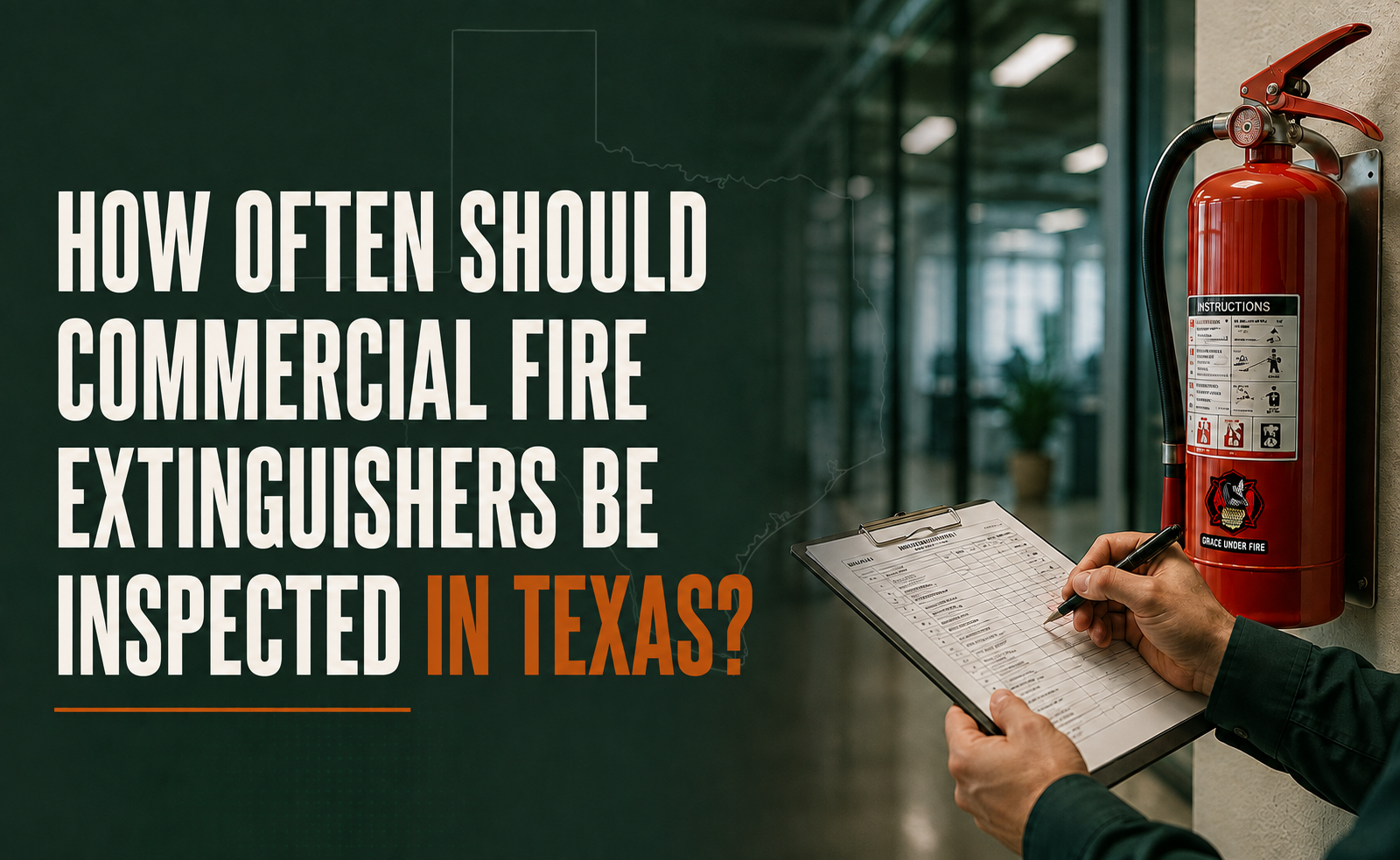
For most commercial properties in Texas, portable fire extinguishers should receive a routine inspection at intervals not exceeding 31 days. They also generally require professional maintenance once a year under NFPA 10 and applicable Texas requirements.
These are different processes. A monthly inspection is a visual readiness check, while annual maintenance is a more detailed professional examination and service. Both are important for protecting employees, customers, visitors and property while supporting fire-code compliance and accurate documentation.
How Often Should Commercial Fire Extinguishers Be Inspected in Texas?
Most Texas businesses should follow two essential schedules: regular inspections at intervals not exceeding 31 days and professional maintenance generally once every year.
An extinguisher should also be inspected when it is initially placed into service. Additional checks may be necessary after it has been used, damaged, moved, exposed to harsh conditions or suspected of being tampered with.
Certain environments may require more frequent inspections. Construction sites, warehouses, industrial facilities and outdoor work areas may expose extinguishers to moisture, vibration, corrosion, extreme temperatures or physical damage.
NFPA 10 also contains an exception applicable to certain extinguishers in buildings containing hospitals. Healthcare facility managers should verify the applicable interval with their authority having jurisdiction, especially because Texas adopts a specific edition of NFPA 10 and local requirements may also apply.
What Does a Monthly Fire Extinguisher Inspection Include?
A monthly fire extinguisher inspection is intended to identify visible problems that could prevent the equipment from being used during an emergency.
The person completing the check should confirm that the extinguisher remains in its designated location and is clearly visible. Furniture, merchandise, equipment and stored materials should not block access.
The extinguisher should be examined for obvious physical damage, corrosion, leakage or signs of discharge. Where applicable, the pressure gauge or indicator should appear within its normal operating range. The safety pin and tamper seal should be present, while the hose and nozzle should appear undamaged and unobstructed.
Operating instructions and important labels should remain legible. The completed inspection should also be recorded using the facility’s applicable documentation method.
This routine check should not become an attempt to repair, recharge or internally examine the extinguisher. If a problem is discovered, the business should arrange for professional evaluation and appropriate service or replacement.
Learn more about commercial inspection procedures here: [INTERNAL LINK – Existing Fire Extinguisher Inspection FAQ].
Is Monthly Inspection the Same as Annual Maintenance?
No. Monthly inspection and annual professional maintenance have different purposes.
A monthly inspection is a basic readiness check. It looks for visible deficiencies involving location, accessibility, pressure indication, damage, corrosion, missing components or possible discharge.
Annual maintenance is a more detailed professional process. It evaluates the extinguisher’s physical condition, components, service history and applicable maintenance needs. The professional must follow the requirements for the extinguisher type, manufacturer information, NFPA 10 and applicable Texas rules.
A business may complete its monthly checks consistently and still have extinguishers that are overdue for annual maintenance. Routine inspections do not replace professional service.
What Happens During Annual Professional Maintenance?
During annual maintenance, a qualified professional evaluates whether the extinguisher remains suitable and ready for service.
The process generally begins by reviewing the extinguisher’s location, visibility and accessibility. The professional examines its cylinder, pressure indication, hose, nozzle, safety components, labels and operating instructions.
The extinguisher’s previous service information is reviewed to determine whether maintenance, recharge or testing is due. Any deficiency that may affect reliability, safe operation or compliance is identified.
When necessary, the professional performs applicable service or recommends repair, recharge, testing or replacement. The exact procedure depends on the extinguisher’s type, extinguishing agent, design, condition, manufacturer requirements and maintenance history.
Following regulated service, the appropriate documentation must be completed. Texas rules require the licensee to attach a service tag describing the work performed. This helps property managers track maintenance and demonstrate that professional service has been completed.
What Does NFPA 10 Say About Fire Extinguisher Inspections?
NFPA 10 is the national standard addressing the selection, installation, inspection, maintenance, recharging and testing of portable fire extinguishers.
In general, NFPA 10 requires extinguishers to be inspected when initially placed in service and then at intervals not exceeding 31 days, subject to applicable exceptions. More frequent checks may be appropriate when extinguishers are exposed to severe hazards, physical damage, corrosion, tampering or other adverse conditions.
NFPA 10 also distinguishes inspection from maintenance. Inspection is a routine confirmation of readiness. Maintenance is a thorough professional examination intended to provide maximum assurance that an extinguisher will operate effectively and safely.
Texas Fire Extinguisher Requirements for Commercial Properties
Portable fire extinguisher work in Texas is regulated through the Texas Department of Insurance and the State Fire Marshal’s Office.
The applicable framework includes Texas Insurance Code Chapter 6001, Title 28 of the Texas Administrative Code, NFPA 10-2018, manufacturer instructions, licensing requirements and service documentation rules.
Under portable extinguishers must be installed, serviced and maintained according to manufacturer instructions and the standards adopted by Texas, subject to applicable local provisions.
Texas also requires a service tag to be attached after regulated service. The tag identifies information such as the registered company, licensee, service date, work completed, extinguisher type and location.
Exact requirements may differ according to the property, occupancy and hazards. A restaurant, warehouse, medical facility, office building and construction site may need different extinguisher types, locations and service considerations.
What Is an FEL-B License in Texas?
FEL-B stands for Type B Portable Fire Extinguisher License.
According to the Texas Department of Insurance, an FEL-B license permits an individual to install, certify or service portable fire extinguishers and test certain DOT non-specification portable extinguishers. Testing DOT-specification extinguisher cylinders must be handled by a Type C registered company.
Individual licenses are issued to people, while company registrations are issued to businesses. Licensed individuals must work for an appropriately registered company when performing regulated extinguisher activities.
This requirement does not mean that every facility employee conducting a simple visual readiness check must hold an FEL-B license. Professional installation, certification, servicing and regulated testing should, however, be completed by appropriately licensed personnel working for a registered company.
What Happens If an Extinguisher Fails Inspection?
An extinguisher may fail an inspection because of low pressure, physical damage, corrosion, leakage, missing components, a damaged hose, blocked access or evidence that it has been discharged.
Other deficiencies can include incorrect placement, unreadable instructions, overdue maintenance or required testing that has not been completed.
Some conditions, such as blocked access, may be corrected immediately. Problems involving the extinguisher itself should be referred for professional evaluation. Depending on the issue, the correct response may be maintenance, recharge, repair, testing or replacement.
A business should also confirm that removing a unit from service does not leave an area without appropriate fire protection.
Fire Extinguisher Inspection Checklist for Texas Businesses
During a routine inspection, confirm that the extinguisher is in its designated location, visible and unobstructed. Look for physical damage, corrosion, leakage or evidence of discharge.
Check the pressure gauge or indicator where applicable. Confirm that the safety pin and tamper seal are intact and that the hose and nozzle appear to be in good condition. Make sure instructions and labels remain legible.
Finally, document the inspection and report any deficiency for professional evaluation. This checklist supports monthly readiness checks but does not replace annual professional maintenance.
Schedule Your Annual Commercial Fire Extinguisher Inspection
Grace Under Fire helps Texas and North Texas businesses maintain inspection readiness, identify deficiencies, document professional service and address commercial fire extinguisher maintenance and replacement needs.
Whether you manage an office, restaurant, retail location, warehouse, medical facility, multi-tenant property, house of worship or construction operation, Grace Under Fire can help you build a reliable commercial fire extinguisher service program.
FAQS
1. How often should commercial fire extinguishers be inspected in Texas?
They should generally be visually inspected at intervals not exceeding 31 days and professionally maintained annually.
2. Is monthly inspection the same as annual maintenance?
No, monthly inspection checks basic readiness, while annual maintenance is a detailed professional service.
3. Who can service commercial fire extinguishers in Texas?
Regulated service should be performed by appropriately licensed professionals working for a registered company.
4. What is an FEL-B license in Texas?
An FEL-B is a Type B license permitting qualified individuals to install, certify and service portable fire extinguishers.